Healthcare
Revenue cycle teams, health systems, and billing companies run EOBs, prior auth packets, medical records requests, and superbills through every channel the payer or clinic will send. Under HIPAA, every touch has to be logged and retrievable, which makes the hand-off between intake, coding, and posting slower than the clinical calendar allows. We build the extraction and routing layer with BAA coverage, audit logging, and PHI handling as part of the core pattern.
Where the week sharpens up
These are the patterns we see in discovery across revenue cycle teams, health systems, and billing companies. If two of the four are recognisable, the pipeline pays for itself inside a quarter.
EOBs and 835 remits arrive as PDFs, paper scans, and portal exports, one payer at a time. Posting teams re-key adjudication, adjustment codes, and patient responsibility into the billing system, then reconcile what posted against what the payer paid. Revenue cycle leaders want the payment, the adjustments, and the patient balance posted to the correct account on the day the remit lands.
We build: EOB and 835 parsing posted to the patient account with adjustment codes and patient responsibility matched to the claim line.
Prior auth denials almost always trace back to a missing clinical note, a missing code, or an outdated payer form. Utilisation review teams want the packet checked against the payer's requirement list before it leaves the clinic, with missing items named and routed back to the ordering provider. One clean submission beats three rounds of back-and-forth with the payer portal.
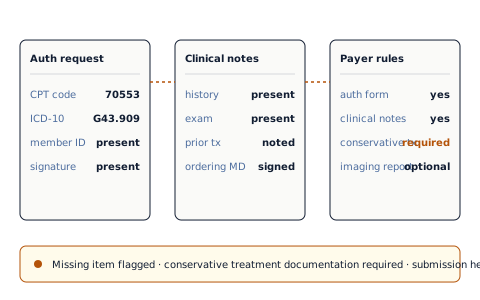
We build: prior auth completeness checks against payer requirement rules, with missing items flagged to the ordering provider before submission.
Medical records requests come in from payers, attorneys, and patients through fax, portal, and mail. Release of information teams spend the week matching the request to the patient, pulling the relevant encounter, checking authorisation scope, and delivering back through the channel that asked. Compliance leads want every step logged against the request ID so the audit answer is one query against the log.
We build: medical records intake threaded by request ID, retrieval scoped to the authorisation, and delivery logged end to end.
Multi-site groups still collect superbills on paper at the point of care, then fax, scan, or email them into central billing. Charge entry teams type them into the billing system on a one-day lag, sometimes two. Billing leaders want the superbill captured at the clinic, charge-coded against the fee schedule, and posted to the billing system the same day the patient was seen.
We build: superbill capture across clinics, charge-coded against your fee schedule and posted to the billing system on the day of service.
Payer portals, provider fax lines, patient portal uploads, clinic scanners. All route into one queue per patient or request ID.
Each document tagged to the patient account or request ID and attached before extraction runs.
Structured parse for 835 and 837 files, form-aware extraction for prior auth packets, handwriting-aware OCR for superbills.
Prior auth completeness against payer rules, EOB line match to the claim, authorisation scope check on records requests.
Clean data posted into Epic, Oracle Health, Athenahealth, or the billing system with source documents attached and a full audit trail.
A prior auth request arrives with the request form, clinical notes, and supporting documents. The pipeline compares the packet against the payer's requirement list, names the missing item, and holds the submission until the provider resolves it. Utilisation review sees a submission-ready packet or a clear reason it is not.
Case studies in this industry
The work in this industry is bound by HIPAA and BAA terms that do not allow public case publication. We can walk through delivery on a discovery call under NDA, including the EOB posting, prior auth, and records retrieval patterns we run.
Free 30-minute call
You'll leave with a clear next step.