Banking and financial services
Regional banks, commercial lenders, and credit unions run loan intake, KYC, wire instructions, and covenant tracking across four systems and a shared inbox. The data gets re-keyed, the audit trail lives in three places, and vendor-risk review stalls the next tool on the stack. We build the extraction and posting pipeline with the audit trail, SR 11-7 model governance, and GLBA handling in the core pattern, not bolted on. The pipeline clears vendor-risk review as one artefact, not a second tool to approve on top.
Where the week sharpens up
These are the patterns we see in discovery across banks, commercial lenders, and credit unions. If two of the four are recognisable, the pipeline pays for itself inside a quarter.
A commercial loan packet arrives as a set of tax returns, financial statements, purchase agreements, and a signed term sheet. The processor re-keys the same fields into the LOS that a reader could have pulled from the term sheet on page one. Credit leaders want extraction tied back to the term sheet so the LOS entry matches the signed document on the first pass.
We build: loan-file extraction against the term sheet, posted into nCino or the LOS with a signed-document audit trail.
KYC packets arrive missing a beneficial-ownership certification, missing an address proof, missing a signature on the CIP form. The relationship manager spends the first call chasing documents that should have been caught at intake. Compliance leads want a completeness check at the door, with the missing-items list generated for the client before the first meeting.
We build: packet-level CIP completeness checks, with a generated missing-items list routed back to the client.
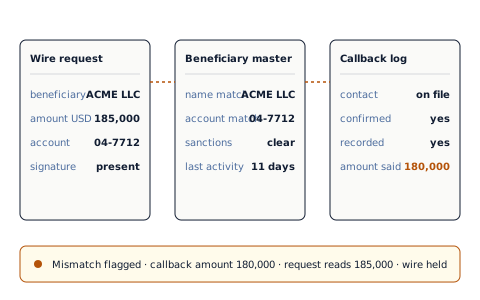
Wire fraud costs the industry by the month. Operations teams want the beneficiary on the incoming instruction matched against the client master, the callback confirmation logged against the request, and the wire held until both checks clear. One release queue, one audit line per wire.
We build: wire intake with beneficiary match against the client master and callback confirmation on the same record.
Covenant certifications arrive quarterly, monthly, or on trigger, and the credit admin team tracks them on a spreadsheet against the loan agreement. When a cert is late or out of compliance, the bank finds out at the quarterly review. Portfolio managers want the cert calendar driven from the loan agreement and every missed or out-of-range cert flagged on receipt.
We build: covenant tracking against the loan agreement, with late and out-of-range certs flagged to the portfolio manager on the day.
Relationship manager inbox, client portal uploads, branch scans, broker submissions. All route into one queue per loan or relationship ID.
Each document tagged to the loan file or relationship record and attached before extraction runs.
Structured parse for term sheets and financial statements, signature and stamp confirmation on CIP forms.
CIP completeness, beneficiary match on wires, covenant calendar, extraction tied back to the signed term sheet.
Clean data posted into the core banking system or nCino with source documents attached and a full audit trail.
A wire request arrives with a beneficiary, an amount, and an account number. The pipeline matches the beneficiary against the client master, confirms the callback has been logged against the request, and holds the wire until both checks clear. Operations sees a release-ready wire or a clear reason it is not.
Case studies in this industry
Each case links to a named client, a named document, and the system of record the data lands in. We publish only what the client signed off to publish.
Commercial loan files extracted against the signed term sheet and posted into nCino with a full audit trail.
→Banking · 2025Credit union · KYC packet completenessCIP completeness checked at intake, with a generated missing-items list routed back to the member before onboarding.
→Free 30-minute call
You'll leave with a clear next step.